Overview
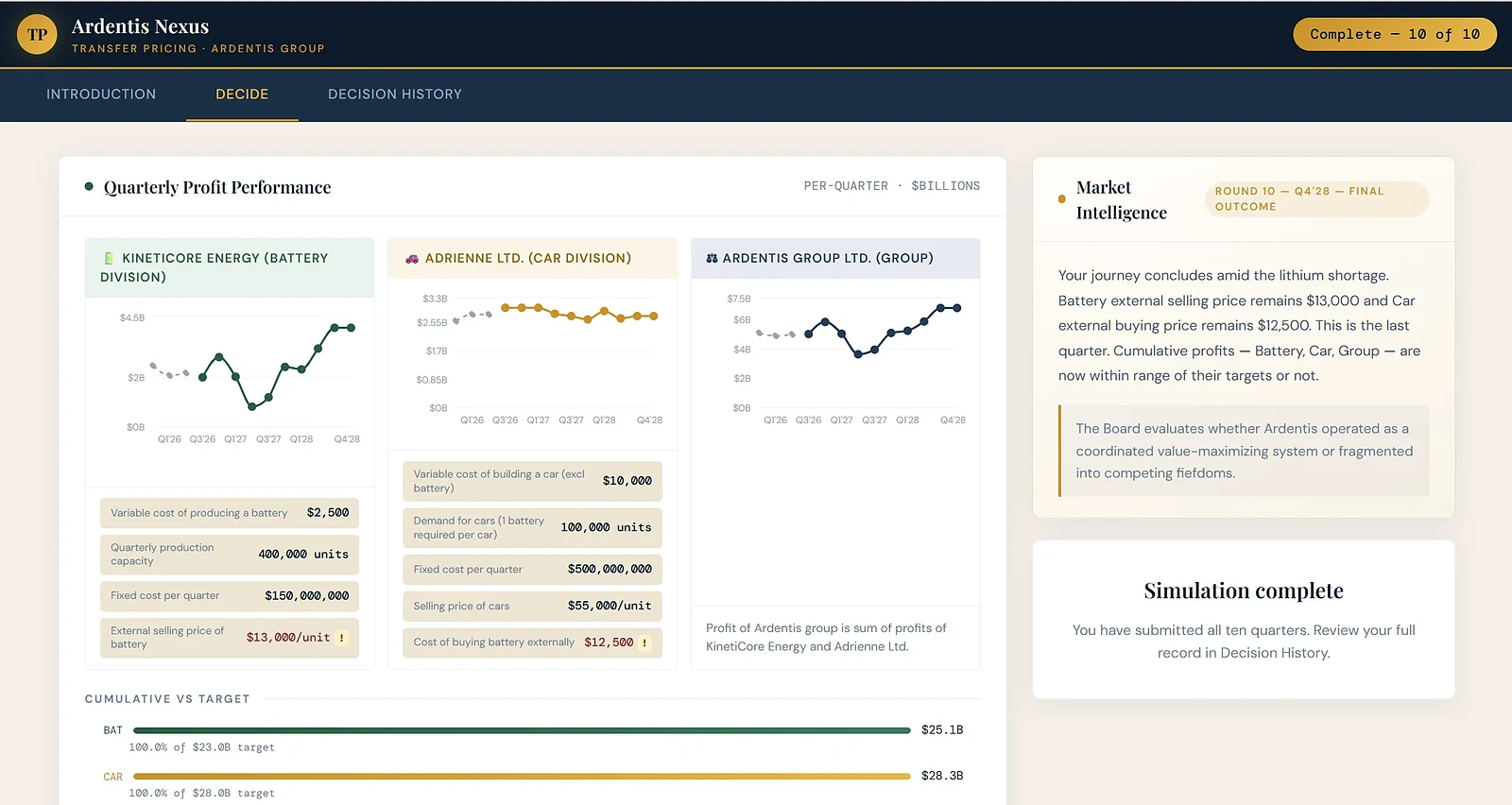
Ardentis Nexus places learners inside a global organization where two business divisions depend on one another. One division produces a critical component; the other needs that component to manufacture and sell the final product. Both divisions are evaluated on their own performance, but the company succeeds only when their decisions create value for the organization as a whole.
Across multiple decision rounds, participants interpret cost structures, external market alternatives, capacity constraints, and changes in demand. They negotiate transfer prices, respond to shocks, and see how a price that appears rational for one division can reduce total company profit.
The simulation turns transfer pricing from a formula-based topic into a lived managerial problem. Learners must work through the tension between divisional autonomy and goal congruence while recognising the role of incremental cost, opportunity cost, unused capacity, and external alternatives.