
Mendelow’s Stakeholder Matrix: Power–Interest Matrix Explained with Examples

Mendelow’s Stakeholder Matrix is a stakeholder analysis tool that classifies stakeholders according to two dimensions: their power to influence an organisation or project and their level of interest in its outcome.
The resulting 2 × 2 power–interest matrix helps managers decide how much attention different stakeholders require and how they should be engaged.
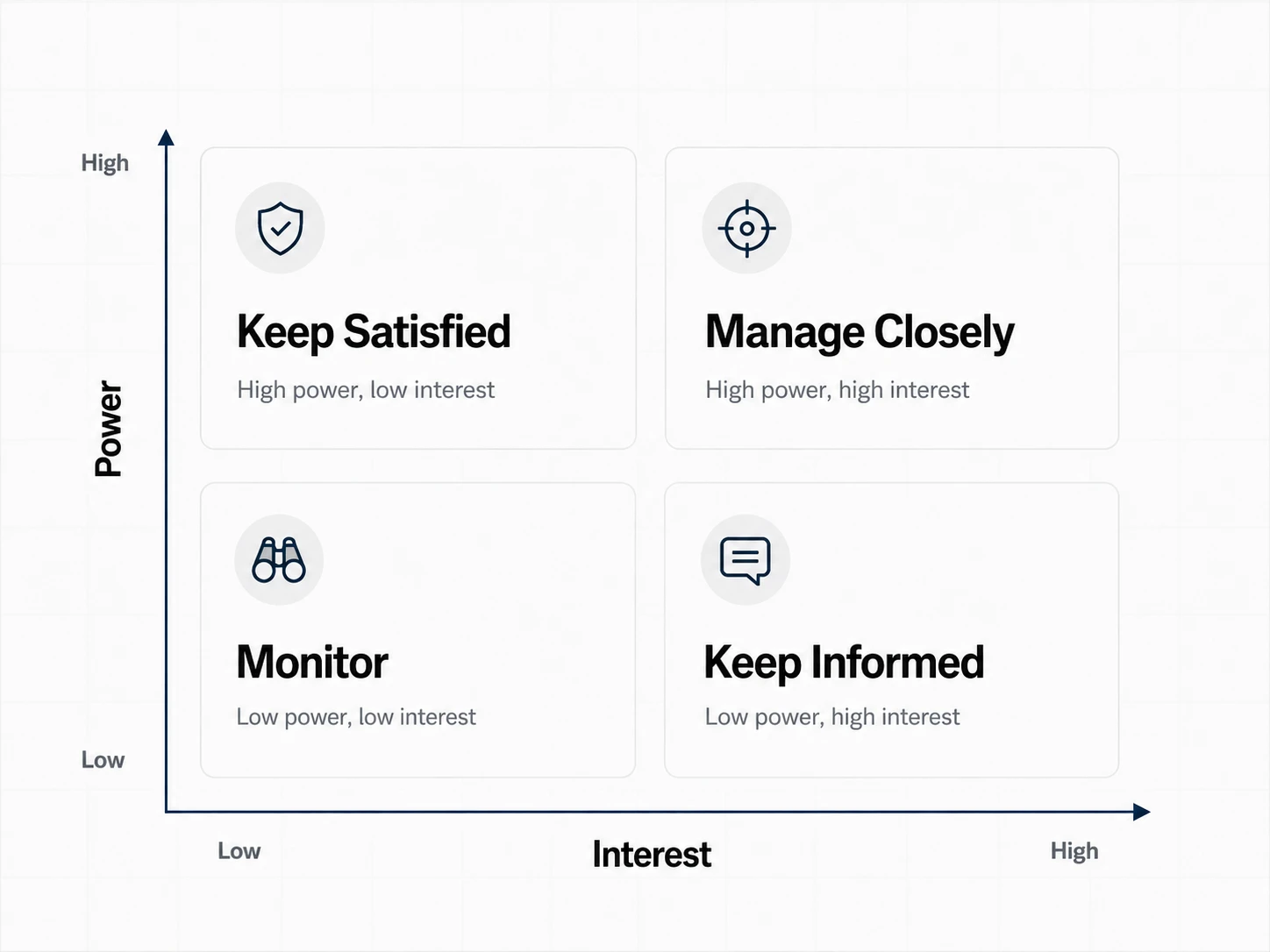
| Power | Interest | Stakeholder Strategy |
|---|---|---|
| High | High | Manage Closely / Key Players |
| High | Low | Keep Satisfied |
| Low | High | Keep Informed |
| Low | Low | Monitor / Minimal Effort |
The principle is simple: organisations should not engage every stakeholder in exactly the same way. A stakeholder with significant power over a project and strong interest in its outcome normally requires much more active management than someone with little power and little interest.
This makes the Mendelow Matrix especially useful in stakeholder management, project management, strategy, change management, marketing, public policy and organisational decision-making.
The Two Dimensions of Mendelow’s Matrix
1. Power
Power refers to the stakeholder’s ability to influence the organisation, project, strategy or decision.
- formal decision-making authority;
- control over budgets or resources;
- regulatory authority;
- ownership or voting rights;
- expertise or information;
- ability to influence other stakeholders;
- public or political influence;
- ability to stop, delay or accelerate a project.
For example, a government regulator may have considerable power because it can approve, restrict or prevent certain organisational activities even if it is not closely involved in the organisation’s everyday work.
Power is not always fixed. Groups with little individual power can sometimes acquire considerable collective influence when they organise around a common issue.
2. Interest
Interest refers to the extent to which a stakeholder cares about, is affected by, or actively follows the organisation, project or decision.
- the outcome directly affects them;
- they have invested significant money, time or reputation;
- their job or responsibilities are connected to the project;
- they strongly support or oppose the proposed change;
- the decision affects their community or customers.
Interest can also change over time. For example, a regulator may initially have high power but relatively low interest in a company. If the organisation breaches an important regulation, that regulator’s interest may increase rapidly, moving it into the high-power, high-interest category.
The Four Quadrants of Mendelow’s Matrix
1. High Power, High Interest — Manage Closely
These stakeholders are often called key players. They have both significant ability to influence the outcome and substantial interest in what happens. They usually require the greatest management attention.
How should they be managed?
- engage them frequently;
- involve them in important decisions;
- understand their objectives and concerns;
- consult them before major changes;
- communicate important developments directly;
- actively manage the relationship.
Examples
- a CEO sponsoring a major transformation;
- the board of directors;
- a major investor;
- the client sponsoring a consulting project;
- a government authority directly overseeing a project;
- a senior executive whose business unit is being restructured.
High power + high interest = involve closely.
2. High Power, Low Interest — Keep Satisfied
These stakeholders can significantly influence the organisation but may not currently be deeply involved in the issue. Because their power is high, ignoring them can be risky. However, overwhelming them with unnecessary detail may also be counterproductive.
How should they be managed?
- provide concise updates;
- understand what matters most to them;
- communicate major developments;
- ensure their requirements are being met;
- avoid unnecessary communication;
- watch for any increase in their interest.
Examples
- regulators;
- government agencies;
- senior executives not directly involved in the project;
- institutional investors;
- influential partners.
High power + low interest = keep satisfied.
3. Low Power, High Interest — Keep Informed
These stakeholders care significantly about the outcome but currently have limited ability to directly influence it. Their views can still be extremely valuable.
How should they be managed?
- communicate regularly;
- explain major changes;
- invite feedback;
- monitor concerns;
- listen for emerging problems;
- involve them where their knowledge can improve decisions.
Examples
- employees affected by a transformation;
- customers;
- local residents;
- junior members of a project team;
- user groups;
- community organisations.
Low power + high interest = keep informed.
4. Low Power, Low Interest — Monitor
These stakeholders currently have limited influence over the issue and limited interest in its outcome. They generally require the least intensive engagement.
How should they be managed?
- communicate only when relevant;
- avoid excessive information;
- monitor whether their position changes;
- reconsider their classification if circumstances change.
Examples
- members of the general public who are not directly affected;
- peripheral suppliers;
- stakeholders with little involvement in a particular project;
- customers unaffected by a specific internal initiative.
Low power + low interest = monitor.
How Do You Use Mendelow’s Stakeholder Matrix?
Step 1: Identify the stakeholders
Start by listing the people or groups who can either influence the project or organisation, or be affected by its decisions. Potential stakeholders might include customers, employees, managers, shareholders, regulators, suppliers, governments, communities, partners, competitors and media organisations.
Step 2: Assess each stakeholder’s power
Ask whether the stakeholder can approve or stop the decision, control important resources, influence senior decision-makers, exercise legal or regulatory authority, or influence customers, employees or the public. Then classify their relative power as high or low.
Step 3: Assess each stakeholder’s interest
Ask how strongly the outcome will affect them, how closely they are following the project, how important the issue is to them, and whether they are likely to actively support or oppose it. Then classify their relative interest as high or low.
Step 4: Place each stakeholder on the matrix
Place each stakeholder into one of the four quadrants: Manage Closely, Keep Satisfied, Keep Informed or Monitor. The purpose is not merely to create the diagram; the real value comes from deciding how the organisation should engage each stakeholder differently.
Step 5: Create a stakeholder engagement strategy
Once stakeholders have been mapped, determine how frequently they should be contacted, what information they need, whether they should be consulted or simply informed, who should manage the relationship, which decisions they should participate in, and whether their position is likely to change.
Mendelow Matrix Example
Consider a company launching a new manufacturing facility. Its stakeholders might include:
| Stakeholder | Power | Interest | Mendelow Category | Possible Approach |
|---|---|---|---|---|
| CEO | High | High | Manage Closely | Frequent involvement in major decisions |
| Environmental regulator | High | Low initially | Keep Satisfied | Compliance updates and proactive communication |
| Local residents | Low | High | Keep Informed | Community meetings and regular updates |
| General public outside the area | Low | Low | Monitor | Broad public communication if required |
Now suppose environmental concerns emerge around the facility. The regulator’s interest could rise substantially. It might therefore move from High Power + Low Interest to High Power + High Interest, and the organisation would need to move from simply keeping the regulator satisfied to managing the relationship closely.
Important principle: Stakeholders do not necessarily remain in the same quadrant. Their power, interest and priorities can change throughout the life of a project.
Can Stakeholders Move Between Quadrants?
Yes. Mendelow’s Matrix should not be treated as a permanent classification of stakeholders.
- organisational change;
- regulatory developments;
- project delays;
- financial consequences;
- media attention;
- leadership changes;
- public controversy;
- new information;
- changing incentives.
For example, a stakeholder who initially has little interest in a project may become highly interested when the project begins affecting their department, budget or reputation. For this reason, stakeholder maps should be reviewed periodically rather than produced once and forgotten.
Why Is Mendelow’s Matrix Useful?
Mendelow’s Matrix helps managers answer a practical question: Where should we focus our limited stakeholder-management attention?
- identify the most influential stakeholders;
- prioritise stakeholder engagement;
- allocate management time more effectively;
- design communication strategies;
- anticipate stakeholder resistance;
- identify potential supporters;
- reduce project risk;
- improve decision-making;
- recognise changes in stakeholder influence.
Without stakeholder prioritisation, managers may spend excessive time communicating with people who have little influence while overlooking stakeholders capable of materially affecting the outcome.
Advantages of Mendelow’s Matrix
Simple: A 2 × 2 framework can quickly make a complicated stakeholder environment easier to understand.
Action-oriented: Each quadrant suggests a different engagement strategy rather than simply describing stakeholders.
Flexible: It can be used for projects, organisations, strategic decisions, marketing campaigns, transformations and policy decisions.
Useful for prioritisation: It forces managers to recognise that stakeholders require different levels of attention.
Easy to communicate: A visual stakeholder map can quickly communicate priorities across a project team.
Limitations of Mendelow’s Matrix
Power and interest can be subjective: Different managers may assess the same stakeholder differently.
Stakeholders change over time: Someone classified as low-interest today may become highly interested tomorrow.
Power is not always obvious: Formal authority is only one form of power. Customers, employees or communities may gain influence collectively even when individual members have little formal authority.
Four categories can oversimplify reality: Stakeholder influence exists on a spectrum rather than simply high or low.
Stakeholder attitude is not explicitly captured: Two high-power, high-interest stakeholders may require very different approaches if one strongly supports a project while another strongly opposes it.
For that reason, managers often combine the Mendelow Matrix with other stakeholder-analysis techniques.
Mendelow Matrix vs Stakeholder Mapping
Stakeholder mapping is the broader process of identifying and analysing stakeholders. The Mendelow Matrix is one particular stakeholder-mapping technique.
- influence;
- legitimacy;
- urgency;
- support versus opposition;
- impact;
- relationships between stakeholder groups.
The Mendelow Matrix focuses specifically on power and interest.
Mendelow Matrix vs Power–Interest Grid
In most business and management contexts, the terms are used to describe essentially the same framework.
- Mendelow’s Matrix;
- Mendelow Stakeholder Matrix;
- Mendelow Power–Interest Matrix;
- stakeholder power–interest matrix;
- stakeholder power–interest grid;
- power versus interest grid.
All describe stakeholder classification according to power and interest and the associated engagement strategies.
Example Questions to Ask When Using Mendelow’s Matrix
Power
- What decisions can this stakeholder influence?
- What resources do they control?
- Can they delay or stop the initiative?
- Whom else can they influence?
Interest
- How strongly does the outcome affect them?
- What do they stand to gain or lose?
- How actively are they following the issue?
- Could their interest increase later?
Engagement
- What does this stakeholder need from us?
- What do we need from them?
- How often should we communicate?
- What information should they receive?
- What would cause their position to change?
This makes the matrix a decision-making exercise rather than merely a classification exercise.
Teaching Mendelow’s Matrix in a Management Classroom
The Mendelow Matrix is straightforward to explain but considerably harder to apply well. Students can usually memorise the four quadrants quickly.
The more difficult managerial questions are:
- How much power does a stakeholder really have?
- Does formal authority equal actual influence?
- What happens when stakeholders have conflicting objectives?
- How should managers allocate limited time across stakeholders?
- When should a stakeholder’s classification change?
- What happens when satisfying one stakeholder damages the relationship with another?
These questions make stakeholder management well suited to case discussion, role-play and experiential learning.
A Short Classroom Exercise for Teaching Mendelow’s Matrix
Faculty can introduce a scenario such as: A company is introducing a major operational change affecting employees, customers, regulators, senior management and suppliers.
Ask student teams to:
- identify the stakeholders;
- estimate each stakeholder’s power;
- estimate their interest;
- position them on the Mendelow Matrix;
- design an engagement strategy for each quadrant;
- explain which stakeholder they would prioritise first;
- revisit the matrix after introducing a new event.
The final step is especially useful because students discover that stakeholder maps are dynamic rather than static.
From Understanding the Matrix to Experiencing Stakeholder Management
Reading the Mendelow Matrix teaches students the framework. Managing a situation in which several stakeholders simultaneously demand attention teaches something different: judgement.
In real organisations, managers rarely receive a neatly labelled stakeholder grid. Instead, they must infer:
- who actually holds influence;
- whose demands deserve immediate attention;
- which stakeholders can safely receive less attention;
- how today’s decision affects tomorrow’s stakeholder relationships;
- how limited time and resources should be allocated.
That is where experiential simulations can complement classroom discussion.
Teach Stakeholder Management Through a Web-Based Simulation
 Stakeholder Management Simulation
The Mendelow Matrix and broader stakeholder management concepts can be taught across a wide range of management programmes, including PGP, MBA, Executive MBA, PGDM, Management Development Programmes, and executive education programmes.
Within these programmes, the concept fits particularly well in courses such as Organisational Behaviour, Strategy, Leadership, Project Management, Change Management, General Management, Business Communication, Management Consulting, and Public Policy or Governance.
Students can usually understand the four quadrants of the Mendelow Matrix quite quickly. The bigger challenge is learning how to apply the framework when stakeholder priorities are unclear, different stakeholders want conflicting outcomes, and managers have limited time and resources.
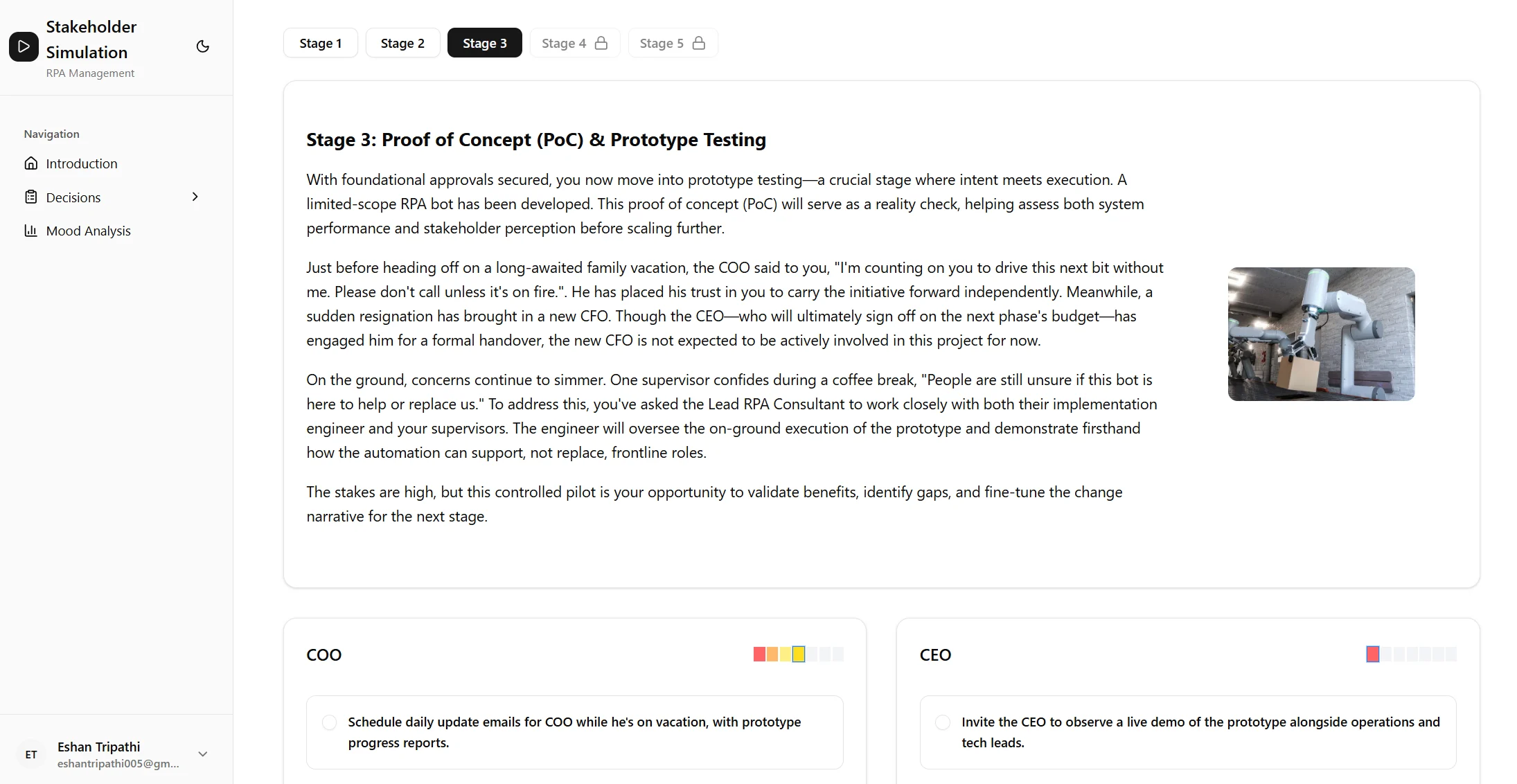
A Stakeholder Management Simulation can help students experience these decisions rather than only discussing them conceptually.
In a web-based simulation, participants can be placed in a realistic managerial situation where they must:
- identify which stakeholders deserve the greatest attention;
- interpret stakeholders’ relative power and interest;
- decide how frequently and deeply to engage different stakeholders;
- respond to competing stakeholder expectations;
- recognise when a stakeholder’s influence or interest has changed;
- make trade-offs when satisfying one stakeholder may negatively affect another;
- observe the consequences of their engagement decisions over time.
This allows faculty to connect the Mendelow Matrix with broader concepts such as:
- stakeholder prioritisation;
- stakeholder engagement;
- competing stakeholder objectives;
- organisational influence and politics;
- communication strategy;
- changing stakeholder power and interest;
- managerial judgement under constraints.
The Stakeholder Management Simulation can therefore be used after introducing the Mendelow Matrix as an experiential learning activity, either during a class session or as a structured exercise followed by faculty-led debrief.
Frequently Asked Questions About Mendelow’s Matrix
What is Mendelow’s Matrix?
Mendelow’s Matrix is a stakeholder-analysis framework that categorises stakeholders according to their power to influence an organisation or project and their interest in its outcome. It produces four engagement strategies: Manage Closely, Keep Satisfied, Keep Informed and Monitor.
What are the four categories of Mendelow’s Matrix?
The four categories are: High power, high interest — Manage Closely; High power, low interest — Keep Satisfied; Low power, high interest — Keep Informed; Low power, low interest — Monitor or Minimal Effort.
What are the two axes of Mendelow’s Matrix?
The two axes are Power and Interest. Power represents the stakeholder’s ability to influence the organisation or project. Interest represents the stakeholder’s level of concern, involvement or attention.
Who are key players in Mendelow’s Matrix?
Key players are stakeholders with high power and high interest. They should normally be managed closely and involved in important decisions.
Which stakeholders should be kept satisfied?
Stakeholders with high power but relatively low interest should generally be kept satisfied. They require enough communication to maintain their support without overwhelming them with unnecessary detail.
Which stakeholders should be kept informed?
Stakeholders with high interest but relatively low power should be kept informed. Regular communication allows their concerns and insights to be understood even if they do not have significant formal influence.
What does Monitor mean in Mendelow’s Matrix?
Monitor refers to stakeholders with low power and low interest. They normally require minimal active engagement, although managers should watch for changes in their power or interest.
Can stakeholders change position in Mendelow’s Matrix?
Yes. Stakeholder power and interest can change because of new events, organisational changes, regulatory developments or emerging conflicts. The matrix should therefore be periodically reviewed.
Why is Mendelow’s Matrix important?
Mendelow’s Matrix helps organisations prioritise stakeholder-management effort. It identifies which stakeholders require close involvement, which need to remain satisfied or informed, and which require only limited attention.
Is Mendelow’s Matrix the same as the power–interest grid?
The terms are commonly used interchangeably. Both describe a 2 × 2 stakeholder map based on power and interest.
What is an example of a high-power, high-interest stakeholder?
A CEO sponsoring a strategic transformation may have both significant authority over the project and strong interest in its success, making the CEO a high-power, high-interest stakeholder.
What is an example of a high-power, low-interest stakeholder?
A regulator can be a high-power, low-interest stakeholder when it has considerable authority over an organisation but limited involvement in everyday activities.
What is an example of a low-power, high-interest stakeholder?
Employees directly affected by an organisational change may have high interest in its outcome but relatively limited formal decision-making power.
Who developed Mendelow’s Matrix?
The framework is associated with the work of Aubrey L. Mendelow on stakeholder analysis and environmental scanning, particularly his work on stakeholder power and interest.
Key Takeaway
Mendelow’s Matrix helps managers decide how to engage stakeholders by mapping them according to power and interest.
The four strategies are easy to remember: Manage Closely → Keep Satisfied → Keep Informed → Monitor.
The harder management challenge is determining where stakeholders actually belong and recognising when their position changes. That is what turns the Mendelow Matrix from a simple 2 × 2 framework into a useful tool for real-world stakeholder management.